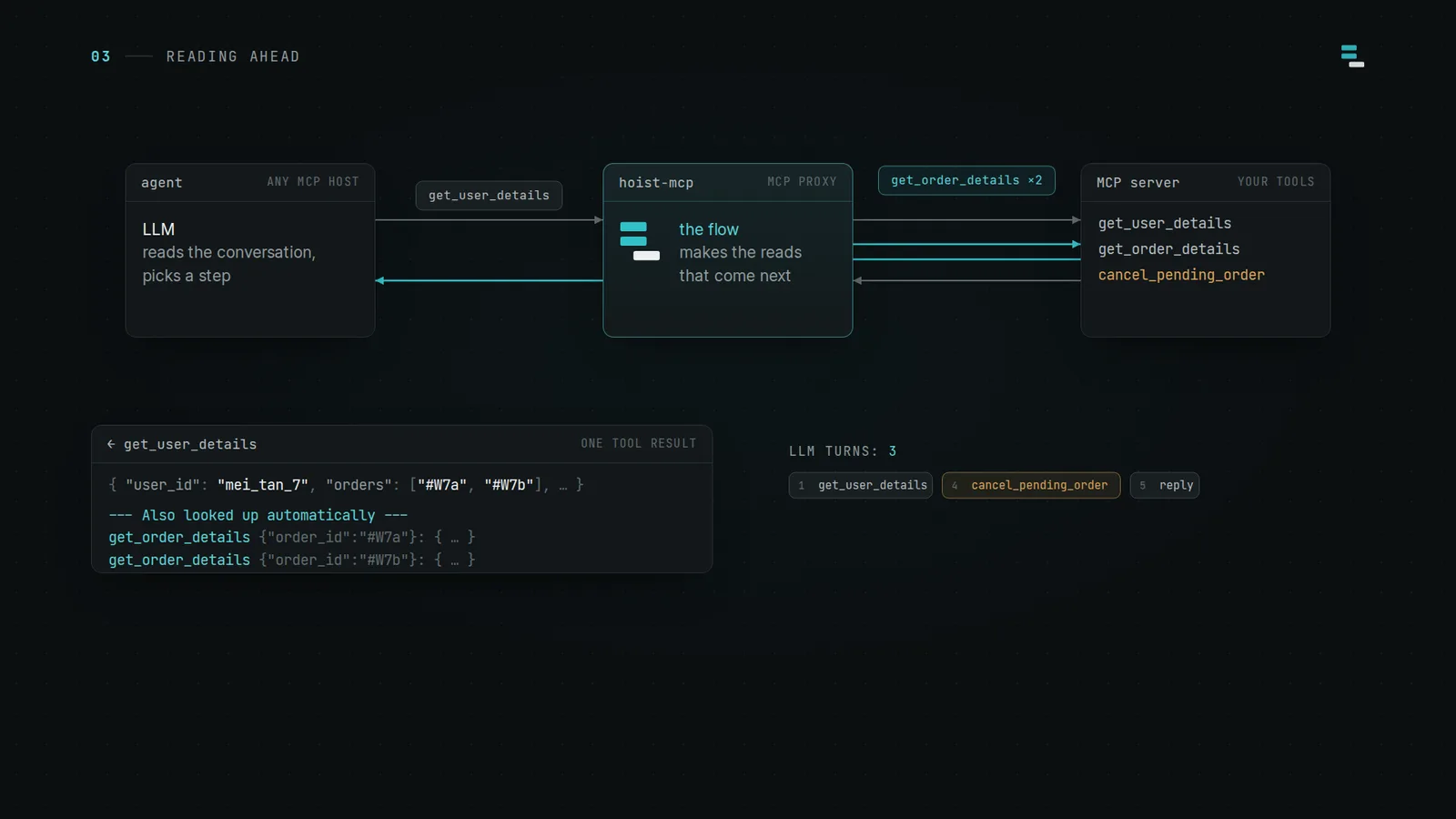
Much of an agent's cost is LLM turns that decide the next call. Many of those decisions are already settled by what the last tool returned: one result names an id, the next call reads it.
Hoist is an MCP proxy that makes those reads for the agent, in the same tool result. It learns by counting, from recorded tool calls, which reads follow which and where their arguments come from. It only reads, and it asks no model.
Live on τ²-bench retail and airline, Sonnet 5 took ~20.5% fewer LLM turns and Haiku 4.5 ~22.4% fewer. How much it saves depends on the domain: there is room where one result points at the next read, and little where each request spells out what to look up.
It's my take, from a probabilistic-programming angle, on what projects like LLMCompiler and TraceCompiler aim at. I'll post about the underlying fugue ecosystem (hand-rolled PPL in Rust) at some point soon too. Interested to hear thoughts from anyone compiling workflows from traces or building on a PPL.
#MCP #LLMAgents #ProbabilisticProgramming #OpenSource
Posted on LinkedIn · the repository · the longer write-up · the paper